Thursday, July 14, 2011

Post 7: Going Batty on Borneo!


Intrepid travelers in front of Clearwater Cave

Mulu, Sarawak, Malaysian Borneo


We had booked an adventure tour which included hiking to and into the longest cave system in Asia and walking the longest rainforest suspension bridge in the world. We spent each day touring the exciting and mysterious Mulu Caves.
The caves we visited were Wind Cave, Clearwater Cave, Deer Cave and  Lang Cave -filled with incredible stalagtites and mites and well lit so you could really see the natural wonders. The Deer Cave (so called because deer liked to come and lick the salt from the bat guano in the cave) was very spooky. This was a BAT cave- populated by 2 million bats. The ceiling was BLACK with hanging bats and the floor covered in guano (smelled awful). The main attraction was that each evening the 2 million bats swarm out of the cave in undulating rivers of flying rodents off to eat 15 tons of insects. This was quite a sight. Tourists walked a ways away from the cave to a viewing site to watch the bats emerge at dusk.


columns in Deer Cave
 
Deer Cave has a natural rock formation that looks like a profile of Abe Lincoln!

tourists viewing the evening bat ritual

bats leaving the cave ( taken from inside)


walkway inside Deer Cave Getting to these caves and back took stamina. We walked through very hot and muggy jungle (on very nice boardwalk all the way) for 6 MILES to go to the Lang and Deer caves. Those who know my normal fitness habits will be mightily impressed with this feat.
jungle boardwalk

Even more impressive is the fact that I actually walked across the LONGEST swaying canopy walkway in the world- at the national park in Mulu. This canopy walk is a series of 9 cable hung bridges stretching from tree to tree 60-80 feet in the air. At the end of some of the swaying walkways there were platforms, others had small connections that went around small trees. The building of this canopy walkway was quite an engineering feat- and the fact that I actually walked it was a feat for me. No one else was nervous about heights.

Di & Fin walk across the suspension bridge


Fin in the treetops

our group of intrepid canopy bridge walkers


Fin walking across a suspension bridge

We really appreciated a shower and a/c when we returned from this walk in the steamy jungle. Next day, we took off early in a longboat to go up river to the Wind and Clearwater caves. On the way we stopped at a Penang Settlement. These are native people who live in longhouses on the river and act as the boatmen and guides for tourists. They also sell handicrafts. I bought a bamboo harp and a jaw harp and a wonderful woven bag to put them in.
  Below are photos of our shopping trip up the river and some of the beautiful ethnic items we purchased.

our boat captain takes us up river


Di buying musical crafts-holding a bamboo harp, bamboo jawharp in my mouth


Fin with our guide,  Ricky


baskets for sale-these have straps & can be worn like a back pack

On display in our living room back home: Sarawak basket, bamboo harp, a sompoton ( bamboo pipes), bamboo rattle

Penang woman making baskets


crafts for sale

Penang long houses

Penang settlement

loading up our longboats

mens earrings-we purchased and framed some

beautifully beaded baby carrier-photo of Kenyah mother & child

I bought a nose harp from this lady!

Sarawak church: Evangelical Church of Borneo


Wind Cave

 We finished our trip up river with a tour to the Wind and Clearwater caves which  were interesting to walk through. They are linked and together form the longest cave system in Southeast Asia. Water has carved the limestone into fantastic shapes and the stalgtites and mites create fanciful towers. To get to the Clearwater cave we had to hike 200 steps straight up. Please do not mention "stair steppers" to me--I have done it!


interesting stalagmite-casts a shadow which looks like Virgin Mary

climbing 200 steps to Clearwater Cave


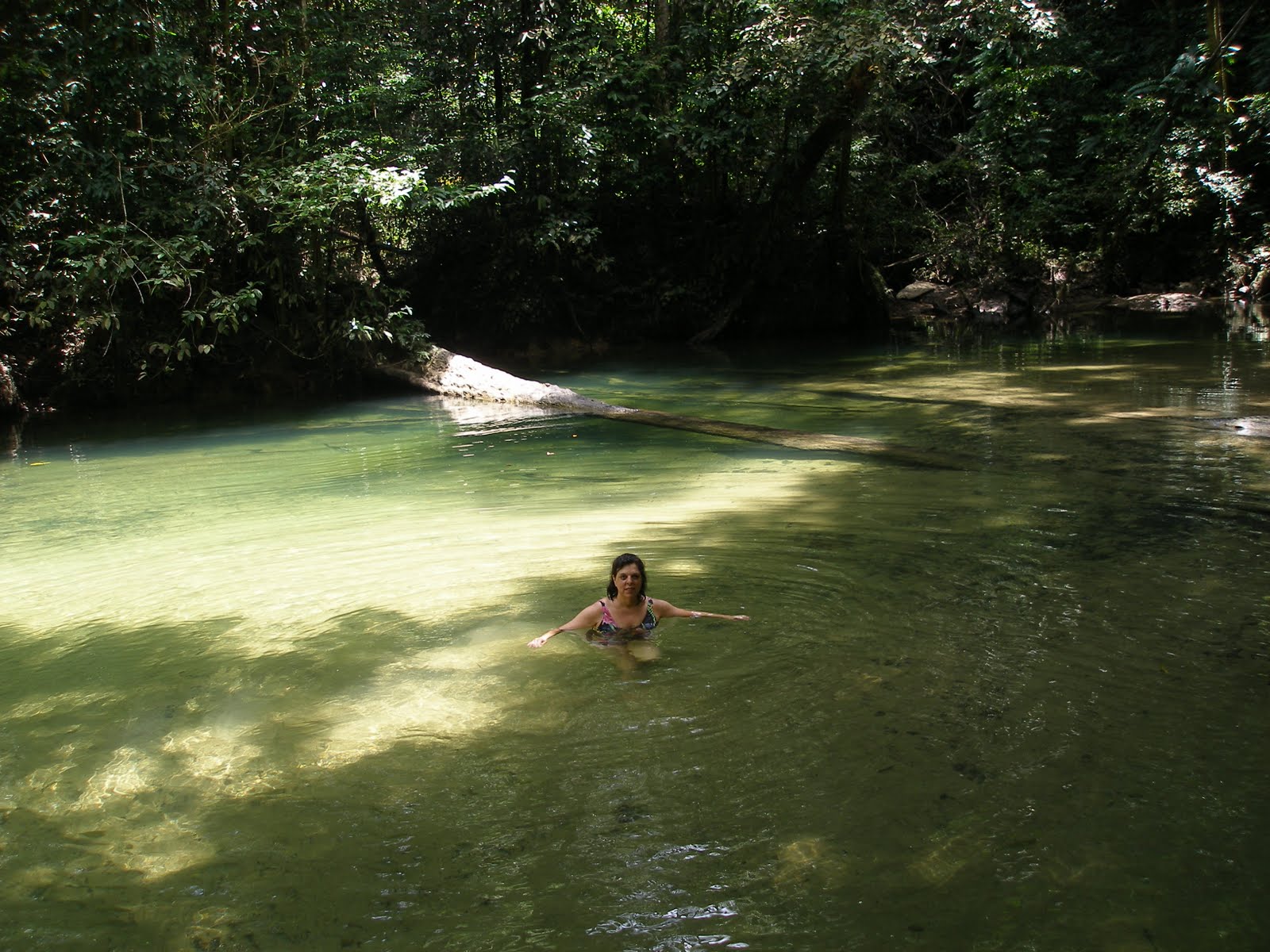
When we finished touring these amazing natural wonders, we took a swim in the river. Water clear and refreshing. We took the thirty minute boat ride back through the jungle wearing our swimsuts and appreciated the cool breeze made by the moving boat.


Enjoying the swimming hole after the cave hikes


Our interesting time in Sarawak was at an end. Time to return to Kuala Lumpur and on to Cambodia!

Saturday, July 9, 2011

Post 6: Seeing Sarawak: Malaysian Borneo


Have you ever heard of Sarawak? Saba? How about the island of Borneo? We knew nothing about this area of the world when we booked a post-conference trip to the Malaysian state of Sarawak.  Looking at a map, we discovered that Malaysia shares Borneo with two other countries: the Kingdom of Brunei and Indonesia. About two thirds of this island is Indonesian Borneo,  known as Kalintang. The Malaysian states of Saba and Sarawak lie along the northern coast and in between them is Brunei.  Sarawak is the largest state in Malaysia - has the largest cave chamber in the world, dense rainforests, and rivers.

Arriving in Mulu

We flew 2.5 hours from Kuala Lumpur on the Malaysian Peninsula to Miri, the northernmost town in Sarawak. Since we had a long layover, we went into town,  cleaned out a handicraft store, then went back to the airport to catch a flight to Mulu. Mulu is in the interior of rainforest Borneo. You can ONLY go there by boat or small plane- NO ROADS. About as far from our regular world as can be.

flying over Mulu, Sarawak

We were met by Paul, a Sarawakan man who expedited our luggage and return ticket business, then  hopped into a covered truck and were driven off to the lovely Royal Mulu Resort. The only road in Mulu connects the airport with the national park and the resort.


Royal Mulu Lodge


This rainforest resort  has many buildings of air conditioned rooms (MUCH appreciated)  - designed in the style of ethnic longhouses  built on stilts  (3 meters above the ground).  Linked by a series of walkways, the resort stands on the banks of a river in the middle of the rainforest. Long boats ply the river- using outboard motors. The native people- Penang, Berwan and other tribes, live on the river banks in either single homes on stilts, or "longhouses" -communal dwellings. While these indiginous  people were once head hunters, they are now mostly evangelical Christians. Our guide explained that  Islam didn't work well for the native ways in the rainforest- where people regularly dine on wild boar!

Penang villagers longhouses on stilts


long boats alongside lodge


The Royal Mulu had a lovely swimming pool and an open air dining area with nice buffet. Each evening at the waiters and waitresses became dancers and put on a cultural show. Quite wonderful in costumes, etc. One part of the show was the blowpipe demonstration! Sorry-no shrunken heads. But they did have a dining area called the Shrunken Head Terrace !  Cultural shows featured a variety of dances from areas of Malaysian Borneo.

Iban head hunter

Mulu Dancers
Fin & Mulu maiden
dancing with rice trays


dancing with "pua kumbo" cloths


blow dart demonstration

playing the "sape" traditional Sarawakan instrument

Mulu Performers

Next post: Exploring the exciting Mulu Caves! 

Tuesday, July 5, 2011

Post 5: Seeking Peanut Butter in Kashmir


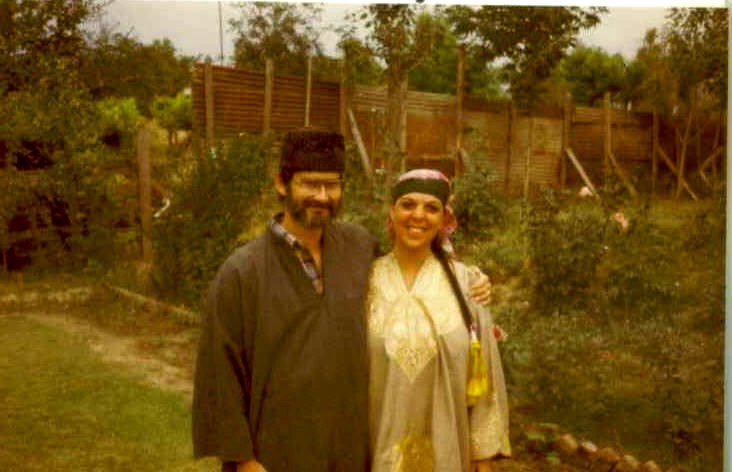
Fin & Dianne in Kashmiri clothing as Ahad & Zuni
Between 1984 and 1989 our family lived an ex-patriot life in Riyadh, Saudi Arabia. We looked forward to traveling the world on holidays. A year after our arrival in Saudi Arabia we decided to see India with our sons, Jesse (then 12) and Brendan (then 7). It was summertime, 1985, and we booked a “Golden Triangle” tour with a car and driver. Our driver, Brahm Singh, drove us from New Delhi to Agra to see the Taj Mahal, through the state of Rajhastan to the city of Jaipur and back to Delhi. Continuing our trip, we left Brahm Singh in Delhi to fly north, to Srinigar in the “Vale of Kashmir,” located in the state of   Jammu & Kashmir, Northern India. 

Nageen (Nagin) Lake
The town of Srinigar is famous for its bridges, lakes, and houseboats.  We stayed  a week on the “Nagin Princess”on Nagin (Nageen) Lake.This was no ordinary houseboat! The Nagin Princess was elegantly carved of local cedar wood and furnished with hand-carved divans, wool and silk rugs, and embroidered curtains and tapestries It was impossibly romantic!
The Nagin Princess
                                                  Our “floating palace” was owned by the Ahmed Wangnoo family, prosperous houseboat hoteliers in Srinigar. The Nagin Princess is part of their YAADAGAR group of boats. The name Yaadgar in Kashmiri mean “a home that cannot be forgotten.”
The Wangnoos were a large family of handsome men with engaging smiles, several wives, and a number of children.  During our stay there, the Wangnoos adopted our family –coming aboard for tea, sharing music with us, taking us sightseeing, even dressing us in Kashmiri outfits and giving us honorary Indian names!
Abdullah Wangnoo & Dianne with a major tan-1985

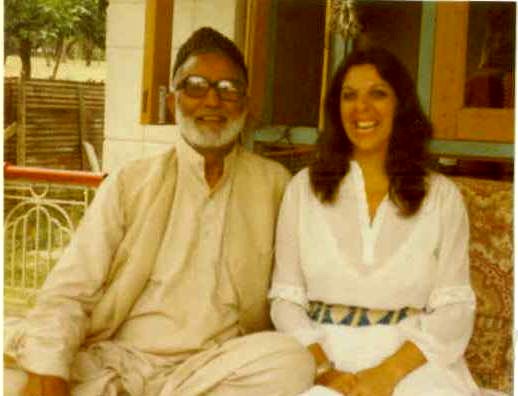
Ahmad Wangnoo & Di on the verandah of the boat

 Lake Nagin is an offshoot of Dal Lake and is surrounded by the Himalayas. Lotus blossoms and water lilies grow in floating gardens and are collected by locals for food for animals, medicine, and wrappings.
                                                      
                                                         
collecting water lilies     
Small, traditonal, wooden boats called shikaras ply the lakes. Shikaras are not to be confused with Shakira, the Columbian pop princess! These beautiful boats are unique to Kashmir and are used for fishing and transporting goods and people. They're rowed with heart-shaped paddles and appear very romantic as they float silently by. All sorts of commerce takes place on these passing gondolas. Each day a flower shikara, rowed by Mr. Marvelous, arrived at our dock, decked with a profusion of fresh flowers.

.

Mr. Marvelous & his flower shikara


 We were also visited by the “Salama Barber” who arrived by shikara to attend to the gentlemen’s needs (ladies,too, if they wished). The barber’s card read:

We did not seek his marriage advice but Brendan and Fin got a shave and a haircut on board our boat!

Brendan getting a haircut on board.
Shave & a haircut...!
One day a shikara filled with beautiful furs and fur coats docked at our boatside. I invited the seller aboard and he showed us gorgeous fur coats made from Himalayan fox and lynx. I bought a full length lynx coat for a reasonable price-to take back to the heat of Arabia. Not exactly a wise purchase but certainly an extravagant one! I still have this coat, it’s in excellent condition and was perfect to wear in Chicago during a blizzard one February.We spent our tourist time swimming, water skiing and sightseeing in such places as the bazaars in Srinigar and the Shalimar gardens. We rode horses up mountain paths near the town of Gulmarg nestled in the Himalayan Mountains. The boys enjoyed rowing shikaras and exploring the lake edge.

Fin & Brendan enjoy a shikara ride.

Jesse rows on Nagin Lake-1985


Guinee cooking breakfast toast 

Our houseboy /cook, named Guinee, took care of our cooking and cleaning needs. He came each morning to make breakfast. His stove was a rustic affair. A large coffee can filled with coals was placed on the floor of an open cooking area. Guinee would make toast by piercing it with a fork and grilling it over the coals, as you do when you are camping. He decorated our dining table with fresh flowers daily and served us Indian dishes of rice and curries. Seven year old Brendan was not enthusiastic about the food choices. His preferred food at the time was peanut butter-a staple of our American family. In Saudi Arabia we spread this liberally on “aesch” the round, flat bread of Arabia, also known as “pita bread”. We generally carried a jar of peanut butter with us to foreign ports but we had run out by the time we reached Kashmir. The Wangnoo family was not familiar with peanut butter. What to do?


One morning a “grocery shikara” rowed up to our boat. The driver was selling all sorts of canned goods and drinks, vegetables and fruits. “Do you have any peanut butter?” I asked. The driver was enthusiastic! He looked about his many items and then pulled up a floorboard –reached in and grabbed an ancient looking jar of peanut butter that was floating beneath the deck in murky water. He held it aloft triumphantly! Despite its appearance, the jar was sealed and apparently safe-so we bought it! For the rest of our stay Brendan was able to eat peanut butter on chapatti and naan along with his tandori, rice and curry with apparently no after effects. I shudder as I think about this now, but at the time, this price for a happy child seemed reasonable!

Happy Brendan with a lily pad hat!


Farewell Toast ( Abdullah toasting, Guninee standing)
On our last night aboard the Nagin Princess, the Wangnoo family treated us to an evening of music. This was quite an honor. As a rule, the owners did not treat guests to such festivities but we had formed a congenial relationship with Abdullah and his brother Ramzan and their families. That evening the ladies dressed me up in authentic Kashmir finery and renamed me “Zuni” (Moon). Fin was also attired and given the name “Ahad”. Guinee decorated our dining table with flower petals which spelled out “Farewel” and  Abdullah joined us for dinner and a toast. Then the entire Wangnoo family came aboard to play and sing with us! They brought a harmonium and tablas (drums) and serenaded us with Indian folk songs. We sang American folk songs back to them: Oh Susanna and  Jingle Bells were favorites!

'farewel' in flower petals

Dianne (center) with the Wangnoo family
A Musical Goodbye
Over the years we lost touch with this beautiful family but discovered, via the internet, that they are still in business, despite the many political troubles Kashmir has had in the years since we have been there.  We will always treasure our idyllic stay there and perhaps we can return because Kashmir has become Yaadgar “the home we cannot forget. “

Reclining on the divan!What a life!

To book your own houseboat stay with the Wangnoo's go to this link: http://www.kashmirboats.com

Post Script: 27 years after this adventure, we made contact with the Wangnoo family again, through this blog (see Mohammed's comment below). In 2012 we traveled to Nagin Lake again! You can read about our recent adventure there in Post # 11.